
KQC7030 IC Design Assignment Brief 2026 | Universiti Malaya
Assignment Type
Individual Assignment
Subject
KQC7030 IC Design
Uploaded by Malaysia Assignment Help
Date
04/29/2026
KQC7030 Assignment Brief

Titles
Common Source Amplifier Performance Trade-off Analysis
Purpose
The objective of this assignment is to investigate the operation of several configuration of common source amplifier and its performance trade-off.
Upon completion of this investigation you should be able to:
- Recognize various performance trade-off in common source amplifiers.
- Optimize the performance trade-off in line to the load of application.
- Analyze and simulate various performance trade-off.
Instructions
Part I Performance Trade-Off Polygon
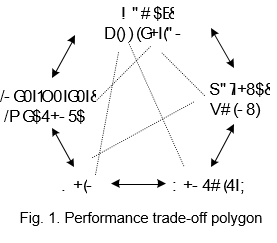
1. Refer to the generic performance trade-off polygon of a typical amplifier in Figure 1.
Part II Common Source Amplifier
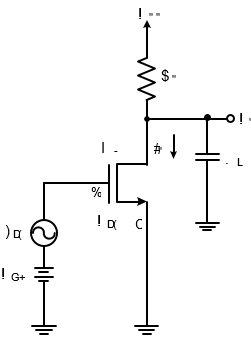
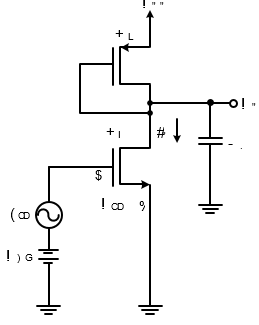
1. Figure 2(a), Figure 2(b) and Figure 2(c) shows the typical common source amplifier with passive loading, diode connected loading and current source loading respectively.
(a)
(b)
(c)
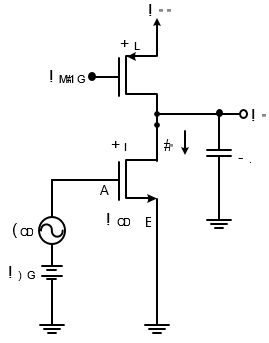
Fig. 2. Common source amplifier with (a) resistive loading, (b) diode connected loading and (c) current source loading
2. By adopting an appropriate small signal model, analyse the circuit in Figure 2(a), Figure 2(b) and Figure 2(c) deriving the small signal performance metric in Figure 1.
3. The total current, Itotal of the circuit in Figure 2 is computed as : & 𝐼!”!#$ = # 𝐼%
%’(,*,..
4. By setting the power dissipation constant, develop and simulate the circuit performance in Figure 2 using CADENCE in 130nm Silterra CMOS technology.
5. Construct an individual trade-off diagram for each of the circuit in Figure 2(a), Figure 2(b) and Figure 2(c) based on the performance metric polygon in Figure 1. You may refer to the performance polygon developed in Figure 8(a) of the reference [1] as guidance.
6. The assignment MUST be uploaded through SPECTRUM in PDF format . The file MUST be named with the matric number of the individuals, such as 17105465.pdf. The first page of the report should be attached with the assessment rubric given in the attachment, followed by the complete report.
7. The report should comply with standard format flow described in Figure 3
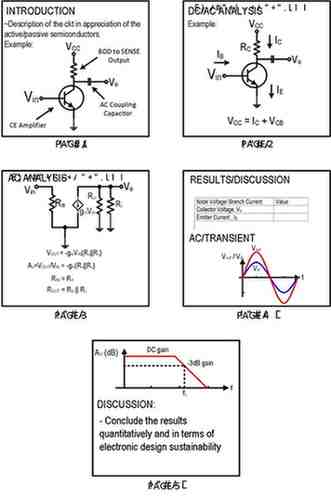
Fig. 3. Report format
Reference
Kishore Kumar Pakkirisami Churchill, Gabriel Chong, Harikrishnan Ramiah, Mohd Yazed Ahmad, Jagadheswaran Rajendran. (2020). Low-voltage capacitive-based step-up DC-DC converters for RF energy harvesting system: A review. IEEE Access, volume 8, pp. 186393-186407
KQC7030 Assessment Rubric – Total :20%
| Questions | Weightage
(%) |
1
(Very Poor)
|
2
(Poor) |
3
(Satisfactory) |
4 (Good) | 5
(Excellent) |
| Describe the fundamental use of CMOS transistor for amplifier design | 2 | The description of the fundamental use of CMOS transistor for amplifier design is poorly presented. | The description of the fundamental use of CMOS transistor for amplifier design is well presented but lacks some detail. | Well presented description of the fundamental use of
CMOS transistor for amplifier design with concrete examples. |
||
| Explain qualitatively/quantitatively the architecture of the circuit with fundamentals of small signal analysis | 5 | Not able to explain the working principle of the circuit with fundamentals of small signal analysis | Partially able to explain the working principle of the circuit with fundamentals of small signal analysis but lacking some details. | Well presented explanation on the working principle of the circuit fundamentals of small signal analysis with complete illustration. | ||
| Presented DC/AC/transient analysis through the use of modern CAD tool like CADENCE. |
8 |
Not able to present
DC/AC/transient analysis through the use of modern CAD tool like CADENCE. |
Partially able to present DC/AC/transient analysis through the use of modern CAD tool like CADENCE with lacking details. | Well presented
DC/AC/transient analysis through the use of modern CAD tool like CADENCE. |
||
|
Present quantitative analysis of the design in the form of trade-off flow diagram with emphasis on sustainable electronic design |
10 |
Not able to present the quantitative analysis of the design in the form of trade-
off flow diagram with emphasis on sustainable electronic design |
Partially able to present quantitative analysis of the design in the form of trade-off flow diagram with emphasis on sustainable electronic design with lacking details. | Well presented quantitative analysis of the design in the form of trade-off flow diagram with emphasis on sustainable electronic design |
Order KQC7030 IC Design Assignment Solution With Universiti Malaya Standard
Get Help By Expert
Many students at Universiti Malaya find this KQC7030 IC Design assignment challenging—especially when it comes to small signal analysis, CADENCE simulation, and understanding amplifier trade-offs.
If you’re also struggling with circuit modelling or performance analysis, you don’t have to handle it alone. You can get expert IC design assignment help from Malaysia Assignment Help, where solutions are prepared as per your university requirements.
To build trust, you can first explore universiti malaya assignment samples, and once confident, choose assignment helper service to get a fully customized, plagiarism-free solution tailored to your topic.

Recommended Assignments for You
Related University Assignments
- GIG1012 Falsafah dan Isu Semasa Assignment Brief 2026 | Universiti Malaya
- MBOE7173 Corporate Innovation and Entrepreneurship Assessment Brief 2026
- CIA1001 Introductory of Accounting Group Assignment 2026 | Universiti Malaya
- GFK0027 Introduction To Biomedical Engineering Individual Written Assignment 2026
- CQD7013 Strategic Management and Planning Continuous Assessment Brief 2026 | Universiti Malaya
- CQD7013 Strategic Management and Planning Assignment Answer 2026 | Universiti Malaya
- KQC7030 IC Design Assignment Brief 2026 | Universiti Malaya
- BQB7004 Principles Of Project Management Assignment | Universiti Malaya
- GBH0033 Developing Workplace Skills Group Assignment Semester 1, 2025/2026
- LIA1002 Introduction to the Malaysian Legal System AY 2025/26 | Universiti Malaya

Convincing Features