
EPSSCOM Electrical Power System Simulation Competition Assessment 2026
Assignment Type
Individual Assignment
Subject
EPSSCOM Electrical Power System Simulation Competition
Uploaded by Malaysia Assignment Help
Date
08/19/2026
EPSSCOM Assessment
Background
Industrial distribution networks are undergoing a fundamental transformation driven by the rapid proliferation of Distributed Energy Resources (DER), including rooftop solar photovoltaics, battery energy storage systems (BESS), grid-forming inverters, and controllable loads. While these resources offer compelling benefits in decarbonisation and operational efficiency, their integration into existing 132/11 kV industrial distribution networks such as data centres, manufacturing facilities, and process plants poses significant technical challenges to network planners and operators.
A key challenge at the core of this competition is the concept of Hosting Capacity (HC): the maximum amount of DER that can be connected to a distribution network without violating statutory power quality, voltage, thermal, and protection limits. For industrial consumers supplied from the TNB 132 kV transmission network, understanding and maximising HC requires rigorous power system studies that go beyond conventional load flow and fault analysis. Planners must account for bidirectional power flows, dynamic voltage regulation, protection coordination under varying generation-load conditions, and long-term network capacity under load growth scenarios.
This competition challenges participants to conduct a comprehensive set of power system studies on a proposed 132/11 kV industrial distribution network. Participants will assess the network’s current technical boundaries, quantify DER hosting capacity, identify binding constraints, and propose advanced planning and operational flexibility strategies to maximise DER integration while maintaining system integrity and reliability.
All analyses shall comply with the latest applicable IEC and IEEE standards.
Proposed Single Line Diagram
The single line diagram below illustrates the proposed 132/11 kV industrial distribution network that forms the basis for all studies in this competition.
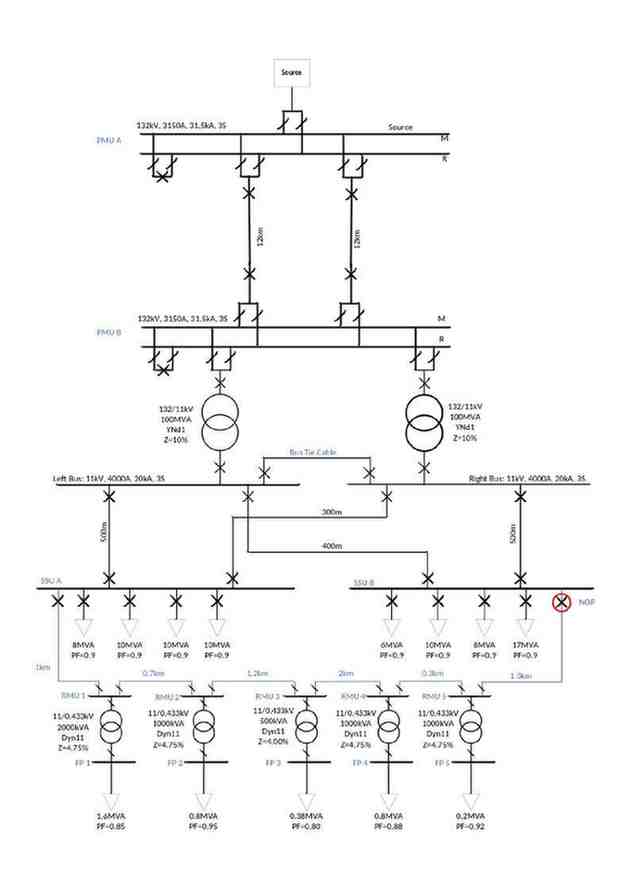
Figure 1. Proposed 132/11 kV network single line diagram
Note: NOP: Normal Open Point
System Data
The following system parameters shall be used as the basis for all power system studies undertaken in this competition.
| Item | Specification |
| Source Impedance | |
| Utility Supply | 2 × 132 kV TNB incoming circuits |
| Incoming Cable | 132 kV XLPE copper cable, 100 MVA each, 12 km. Refer to Appendix A. |
| Gas Insulated Switchgear (GIS) | 145 kV GIS, double busbar with bus coupler, 3150 A, 31.5 kA for 3 s |
| Transformer | 2 × 100 MVA, 132/11 kV, Z = 10%, YNd1 |
| 11 kV Switchgear | 4000 A, 20 kA for 3 s |
| 11 kV Cable | SSU A – RMU 1: 3C XLPE AL 240 mm² RMU 1 – RMU 2: 3C XLPE AL 240 mm² RMU 2 – RMU 3: 3C XLPE AL 240 mm² RMU 3 – RMU 4: 3C XLPE AL 240 mm² RMU 4 – RMU 5: 3C XLPE AL 240 mm² RMU 5 – SSU B: 3C XLPE AL 240 mm² Refer to Appendix B. |
| Ring Main Unit (RMU) | 630 A, 20 kA for 3 s |
| Feeder Pillar (FP) | 1600 A, 31.5 kA for 3 s |
Competition Questions
Participating teams are required to address the following six questions in full. Detailed working, assumptions, and software outputs must be included in the submitted report, following the Report Structure Guidelines set out later in this document.
Question 1 Baseline Load Flow and Voltage Assessment
Perform a steady-state load flow analysis on the proposed 132/11 kV network under peak and minimum loading conditions. Evaluate:
- Bus voltage profiles, cable and transformer loading percentages, and active/reactive power losses.
- N-1 contingency performance for the loss of one incoming 132 kV feeder and one transformer. Voltage regulation compliance and identification of any bus voltage violations.
- Power factor performance and the need for reactive power compensation. Assume the utility requirement is 0.90 minimum. Propose solutions with sizing.
Propose 11 kV outgoing cable sizing for:
- PMU B to SSU A
- PMU B to SSU B
Bus tie cable from left bus to right bus Refer to the cable specifications in Appendix B D.
Question 2 Short Circuit Analysis and Equipment Rating Verification
Perform an IEC 60909 short circuit analysis for three-phase and single-phase-to-earth faults. Determine:
- Maximum and minimum fault levels at all major busbars (132 kV and 11 kV).
- Whether existing switchgear, cable, RMU, and FP equipment ratings are adequate; recommend upgrades or mitigation if fault levels exceed ratings.
- The earth fault current magnitude for a single-line-to-earth fault on the 11 kV cable. Explain the governing factors and identify any missing earthing provisions in the design.
- How the connection of DER (inverter-based generation and BESS) modifies fault current contributions, and whether equipment ratings remain valid under DER integration scenarios.
Question 3 Protection Coordination and DER Integration Develop
a protection philosophy for:
- The 132 kV incoming cable protection.
- The 132/11 kV transformer protection.
- 11 kV feeder protection.
- Perform protection coordination studies for overcurrent and earth fault protection, where applicable.
In addition, address how the introduction of DER at the 11 kV level affects:
- Directional protection requirements and relay coordination.
- Anti-islanding protection and loss-of-mains detection.
- The need to update protection settings as DER penetration increases.
Question 4 Hosting Capacity Assessment
Quantify the DER hosting capacity of the 11 kV distribution network using a deterministic or probabilistic approach. Specifically:
- Determine the maximum PV generation that can be connected before any statutory voltage, thermal, or fault-level limit is violated.
- Identify the binding constraint (voltage rise, thermal overload, or fault level) that limits HC under different load scenarios (peak, off-peak, minimum load).
- Assess how BESS placement and sizing can be used to shift the HC constraint and increase overall DER penetration.
- Propose optimal DER and BESS locations to maximise HC across the network.
Question 5 Advanced Planning for Load Growth and DER Expansion
Develop a 10-year network capacity plan that accounts for projected load growth (5% per year) and increasing DER penetration. Address:
- The impact of load growth on transformer and cable utilisation, and the staged reinforcement required to maintain adequate hosting capacity.
- A DER integration roadmap specifying technology type, sizing, phasing, and grid connection requirements for each stage of expansion.
- The role of operational flexibility measures (demand response, BESS dispatch, smart inverter volt-var control) in deferring or avoiding capital network reinforcement.
Recommended Software
Participants may use any of the following software packages, or other recognised power system analysis tools, to complete the required studies:
- DIgSILENT PowerFactory
- ETAP
- PSS®E
- Power World
- SKM PowerTools
- EasyPower
- MATLAB / Simulink
- Other software
Are You Struggling With Your EPSSCOM Electrical Power System Simulation Assessment?
Get Help By Expert
Do you also find DER hosting capacity, BESS sizing and network constraints difficult to analyse in your EPSSCOM electrical power system simulation competition assessment? Many students struggle to decide which constraint limits the network and how BESS can improve hosting capacity. This is why students choose Malaysia Assignment Help for engineering assignment help. Explore our uniten assignment examples and receive a solution written around your assessment questions and technical requirements.

Recommended Assignments for You
Related University Assignments
- EPSSCOM Electrical Power System Simulation Competition Assessment 2026
- COEB1013 Programming for Engineers Project Semester 1 2025/26 | UNITEN
- EEPM553 Power Systems Operation and Planning – Case Study Project, Semester 1, 2025/2026 | UTN Malaysia
- Crane System Design Assignment: DC Motor Simscape Model and Load Control
- Programming Café Management System In order to improve the student’s performance, and enhance their problem: C Programming Assignment, UTN, Malaysia
- UNIM513: Identify problems or issues in business and management and to justify the need for research: Research Methodology Research Paper, UTN, Malaysia
- UNIM513: Design quantitative, qualitative, and mixed methods approach research: Research Methodology Assignment, UTN, Malaysia
- Provide a brief discussion on the importance of the external environment and internal analysis of the organizations: Business Administration Report, UTN, Malaysia
- With respect to the money and capital markets, money market securities generally have, while capital market securities are typically expected to have a: Financial Institution Monetary Theory Other, UTN, Malaysia
- An alisisperanan nstitusi agama seperti masjid, tokong, gudhwaraataugerejauntukmengatasikonflik agama di Malaysia: Hubungan Etnik Assignment, UTN, Malaysia

Convincing Features