
MRTB 1113 Data Governance Assessment Brief 2026 | UTM Malaysia
Assignment Type
Individual Assignment
Subject
MRTB 1113 Data Governance
Uploaded by Malaysia Assignment Help
Date
07/20/2026
MRTB1113 Assessment Brief
| Course Code | MRTB 1113 |
| Course Name | Data Governance |
| Year / Programme | 1 / Master Of Business Intelligence & Analytics |
| Duration | 2 Weeks |
Instruction
You are required to answer ALL questions below in a clearly structured written report:
i. A standard A4 page with default margins.
ii. Aptos Font type
iii. 11- font size.
iv. 1.5 line spacing.
v. Average 3,000-3,500 words.
vi. Include any relevant diagrams or tables where appropriate.
vii. Including References and Appendix.
Answer All Questions (60 MARKS)
Question 1
CASE STUDY: LESTARI ENERGY BERHAD (LEB) – The Organizational Context
Lestari Energy Berhad (LEB) is a cornerstone of Malaysia’s national infrastructure, providing electricity to millions. Following the National Energy Transition Roadmap (NETR), the Board of Directors has launched the Lestari Digital 2050 or Net Zero 20250 initiative. The goal is to transform from a traditional utility provider into a Smart Grid operator.
However, LEB suffers from a Silo Legacy. The three primary divisions: Generation (Power plants), Transmission (National Grid), and Distribution (Retail and Metering) are operating as independent kingdoms. Each has its own legacy IT department, its own database schemas, and a culture of data protectionism where sharing information is seen as a loss of power. A preliminary audit shows that LEB is currently at Maturity Level 1 (Initial), with no standardized data dictionary, and data quality is managed as a “firefighting” exercise by IT.
Using the above scenario, answer the following questions.
i. Q1.1 [Level 6- 4 marks]
Operating Model & Accountability (4 Marks): Design a Federated model and define the specific decision- making authorities for the Group Chief Data Officer versus the Business Unit Data Stewards.
ii. Q1.2 [Level 3 – 8 marks]
Policy as a Strategic Enabler (8 Marks): Prepare a high- level Data- as- an- Asset Policy Statement (maximum 200 words) that specifically addresses the tension between subsidiary autonomy and the need for standardized data sharing for the Net Zero initiative.
iii. Q1.3 [Level 6 – 3 marks]
Maturity Roadmap (3 Marks): Recommend THREE (3) critical capabilities LEB must develop to transition from Level 1 (Initial) to Level 3 (Defined). Your answer must include specific references to institutionalizing processes.
(15 marks)
Question 2
CASE STUDY: MYKOTA SMART CITY COUNCIL (MSC) – DATA ECOSYSTEM, OWNERSHIP AND GOVERNANCE CONTROL
MyKota Smart City Council (MSC) is a Malaysian local authority that manages citizen services, public transport coordination, waste collection, traffic monitoring, and community safety. To improve service delivery, MSC has introduced several digital initiatives, including a citizen complaint app, smart parking system, CCTV analytics, waste collection dashboard, and traffic sensor network.
Although these initiatives generate large volumes of useful data, each department manages its data separately. The Urban Mobility Unit owns traffic and parking data, the Community Services Unit manages complaint records, the Waste Management Unit maintains collection data, while the IT Unit controls system access and infrastructure. External vendors also host several platforms under different service contracts.
MSC is now facing several governance concerns:
a. Departments disagree on who owns shared datasets, especially when citizen complaints involve traffic, waste, public safety, and vendor performance.
b. Data sharing between departments is slow because there is no clear approval process, no standard classification of sensitive data, and no agreed escalation path.
c. Citizen records, complaint categories, location codes, and service status updates are interpreted differently across systems.
d. Some dashboards are built using vendor-managed data, but MSC has limited visibility over data lineage, access logs, retention rules, and data reuse.
e. The Mayor’s Office wants to use integrated data for better city planning, but legal, ethical, privacy, and public trust concerns remain unresolved.
f. Using the above scenario, answer the following questions.
i. Q2.1 [Level 5 – 10 marks]
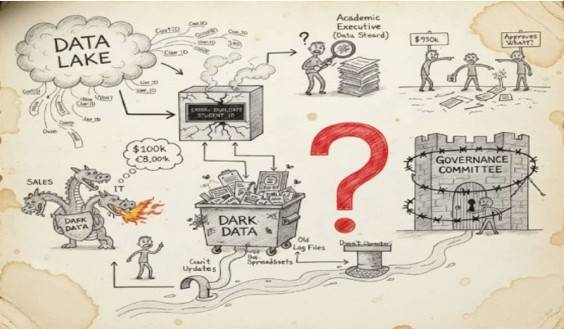
Develop a Rich Picture that visualises MSC’s data governance situation. Your rich picture should clearly illustrate:
- key stakeholders, such as the Mayor’s Office, departments, IT Unit, vendors, citizens, and regulators;
- main data assets and flows, such as complaint data, traffic data, parking data, CCTV- related data, location data, and service performance data;
- conflicts, tensions, bottlenecks, or unclear responsibilities in data ownership and data sharing;
- privacy, ethical, legal, and public trust pressures affecting the use of smart city data;
- possible governance intervention points, such as a Data Governance Council, data owner, data steward, approval workflow, or data sharing agreement.
You may create the rich picture using hand- drawn sketches or digital drawing tools (e.g., draw.io, PowerPoint, Visio, Miro, Lucidchart). Al- generated diagrams, images, or automated visualisations are not allowed. Students must produce the rich picture themselves.
Sample of Rich Picture:
For illustration purposes only. You must draw your own rich picture with reference to MSC case).
ii. Q2.2 [Level 4 – 3 marks]
Based on your rich picture, identify THREE (3) priority data assets or data domains that MSC should govern first. Present your answer in a simple table with the following columns: Data Asset / Domain, Main Stakeholders, Why It Should Be Prioritised.
iii. Q2.3 [Level 5 – 7 marks]
Construct a practical RACI table for MSC’s data governance structure. Your table must use suitable job titles or governance bodies from the case and clearly assign responsibility for key data governance activities across departments and vendors. Your RACI table should include at least FOUR (4) roles or bodies, such as:
- Data Governance Council
- Chief Data Officer or senior sponsor from the Mayor’s Office
- Departmental Data Owners
- Data Stewards
- IT/Data Custodians
- Vendor Data Liaison or Contract Owner
Your table should include at least FIVE activities related to data ownership, data definition, data sharing approval, access control, vendor- managed data, or issue escalation.
(20 marks)
Question 3
Innova Retail Solutions Sdn. Bhd. is a medium- sized company in Malaysia that provides e- commerce and customer management services to more than 200,000 active users. The company has approximately 350 employees and several branches located in Kuala Lumpur, Johor Bahru, and Penang.Over the past few years, the company has experienced several issues related to data management, including:
- Customer data is stored across multiple systems without clear standards.
- Employees share customer files using personal cloud storage applications without proper security controls.
- Outdated customer records have caused delivery and operational errors.
- The company does not have any formal policies related to data compliance or information security.
- Top management has recently decided to implement Data Governance (DG) practices to ensure compliance with the Personal Data Protection Act (PDPA) Malaysia and information security best practices based on ISO 27001.
As a Data Governance consultant, you are required to assist the company in developing basic operational policies to initiate its Data Governance implementation.
i. Q3.1 [Level 2-5 marks]
Identify and explain THREE (3) major data management issues faced by the company based on the case study above. Discuss the impact of these issues on the organization’s operations.
ii. Q3.2 [Level 5-10 marks]
Recommend TWO (2) operational Data Governance policies that are suitable for the company during the initial stage of implementation. The policies may include Data Compliance Policy, Data Security Policy, Data Access Policy, Data Quality Policy, or any other relevant policy. For each policy:
- State the objective of the policy
- Explain at least THREE (3) key components of the policy
- Discuss how the policy supports compliance with Malaysia Personal Data Protection Act 2010 [Act 709]
text-align: right;”
(15 marks)
Question 4
Reflective Use of Generative AI
Generative AI tools such as ChatGPT, Gemini, Copilot and Claude are commonly used to support academic tasks. To ensure responsible use, students must demonstrate critical judgement, awareness of limitations, and ethical reflection when integrating AI-generated content into their PMA answers. This question evaluates how you used Generative AI while completing Q1, Q2, and Q3 in this assessment.
i. Q4.1 [Level 3 – 6 marks]
State whether you used any Generative AI tools while completing this PMA.
If AI tools were used, name the tools and explain the purpose of using each tool (e.g., brainstorming, summarising, drafting, concept clarification).
If no AI tools were used, briefly explain your alternative approach to completing the assessment (e.g., literature review, independent research, discussions with peers, lecture materials).
ii. Q4.2 [Level 6 – 4 marks]
Append your AI prompt history in the Appendix as evidence (you may provide screenshots). Each item must be clearly labelled according to the question it supports (e.g., Q1 – AI Prompt 1, Q2 – AI Output 2 etc.). Assess how this evidence demonstrates transparency and responsible AI use.
Order a Custom MRTB1113 Data Governance Assignment Solutions Today
Get Help By Expert
Many UTM students find this MRTB1113 data governance assessment challenging because it involves case study analysis, Data Governance policies, RACI matrices, rich pictures, PDPA Malaysia, ISO 27001 and critical evaluation. If you're finding these tasks difficult or don't have enough time to complete them, Malaysia Assignment Help provides custom case study assignment help prepared according to UTM standards and course requirements. You can also explore our UTM assignment sample to see the quality of our work or Hire pay someone to do my assignment and receive an expert-written model solution prepared specifically for your assessment.

Recommended Assignments for You
Related University Assignments
- MBSA 1413 Accounting for Business Decision Making Assignment Brief 2026 | UTM
- DSPD 1243 Digital Logic Assignment Lab 1 – Logic Gates 2026 | UTM
- MBSA 1713 Business Research Assignment Brief 2026 | UTM
- SKEE3143 Control System Design Assignment Brief 2026 | UTM
- MRTB 1113 Data Governance Assessment Brief 2026 | UTM Malaysia
- MBSA 2113 Modern Data Management Assignment Brief 2026 | UTM
- MBSA 2363 Marketing Analytics Assignment Brief 2026 | UTM Malaysia
- MBSA2123 Persuasive Visualization Assignment Questions 2026 | UTM
- SEAA3243 Theory of Structures Case Study Project 2026 | UTM
- MMEH2073 Project Management Assessment Brief 2026 | UTM Malaysia

Convincing Features