
SEAA 3243 Theory of Structures Case Study Semester 1 2025/2026 | UTM
Assignment Type
Individual Assignment
Subject
SEAA 3243 Theory of Structures
Uploaded by Malaysia Assignment Help
Date
01/19/2026
SEAA 3243 CASE STUDY (COMPLEX PROBLEM)
Failure of Continuous Beams in a School
Prologue
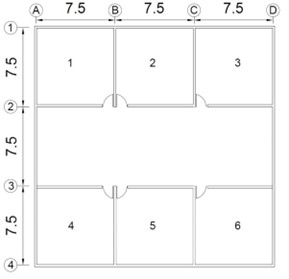
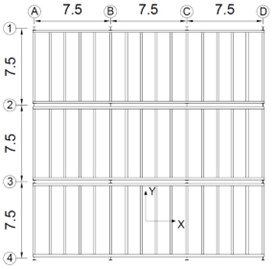
In 2005, a new three-story school building was constructed in a small city. The structure was composed of steel framing and consisted of three identical stories. Each story contained six classrooms, as illustrated in Figure 1. In both principal directions, the building comprised three spans, each measuring 7.5 m in length. The typical floor framing plan is presented in Figure 2.
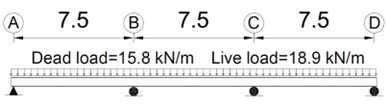
The beams in the X-direction were designed as continuous I-shaped members with identical cross-sections, whereas those in the Y-direction were simply supported with pinned connections at both ends. The continuous beams were designed to resist a dead load of 15.8 kN/m and a live load of 18.9 kN/m, as shown in Figure 3.
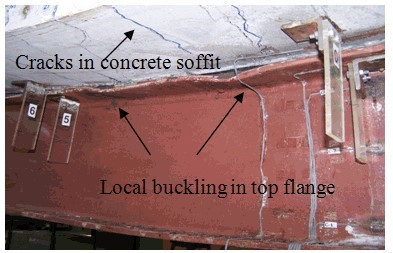
Several weeks after the building’s inauguration, noticeable cracks appeared in the gypsum ceiling attached to the soffit of the continuous beams. Upon removal of the ceiling, local buckling and yielding were observed in the top flanges of several beams, as shown in Figure 4. Consequently, the school administration appointed a consulting engineering firm to investigate the cause of the observed distress.
INVESTIGATION INSTRUCTION
Assume that you are appointed as the consulting company to investigate the failure of the continuous beams. The investigation can be resolved through in-depth engineering knowledge using a fundamental-based approach (WP1). Below is the scope of work that you are expected to fulfill.
- Determine what type of material and structural tests you may need to conduct in order to carry out your investigation.
- Analyze the continuous beam for the following conditions and draw the bending moment and shear force diagrams for each case. This can be achieved through systematic and theory-based formulation fundamentals in the analysis process of the civil engineering discipline (WK3).Case 1: all class rooms are occupied with students. This is the case in which the continuous beams were designed for. As shown in Figure 3 all dead and live load should be applied on all three spans of the continuous beam.Case 2: only the class rooms between span AB and CD are occupied with students (i.e., class rooms 1 and 3). For this case, the continuous beam should be loaded on all spans with the given dead load, but the live load should be only applied on span AB and span CD.Case 3: only the class rooms between span AB and BC are occupied with students (i.e., class rooms 1 and 2). For this case, the continuous beam should be loaded on all spans with the given dead load, but the live load should be only applied on span AB and span BC.
- Prepare a report based on the conducted tests and performed analyses. Your report should include followings:
- Compare the bending moment and shear force diagrams of the continuous beam for all three cases and determine the largest positive and negative bending moments and shear forces.
- What are the most probable reasons for the failure of the continuous beam based on the obtained results from the analysis? There is no obvious solution for this task, so you are required to formulate suitable hypotheses using your knowledge and abstract thinking with some originality in analysis (WP3).
- Do you think the columns supporting the continuous beams may be also unsafe? Describe your reasons based on the calculated support reactions from your analysis.
- How can we retrofit the continuous beam to make sure it can safely transfer the forces to the columns?
- What lesson you learnt from your investigations? What is your recommendation to avoid such failures in the future?
🔹 Need Help With SEAA 3243 Theory of Structures Case Studies?
FULL REPORT INSTRUCTION
This is a group project. The group members of maximum five (5) people will be assigned by the lecturer in the beginning of the semester. 10% of the total marks from the report and presentation will be carried into the final mark for the course.
Learning outcome
After finishing this group project, the students are expected to be able to:
- Appreciate the role of engineers in solving complex engineering problems through case study.
- Learn and practice good presentation skill
- Write professional technical report
- Work in a team
Report
In this case study project, you are required to write a group report. The maximum length of the report must not exceed 15 pages of A4 paper, 1.5 line spacing, and 11 font size including figures, pictures and references. The components of the report should include the scope of works given by the client while at the same time professional report writing need to be followed.
Presentation
Prepare the slides for a maximum 10 minutes presentation about the case that your group is reporting. Submit the file to your class lecturer in week 14 (depends on lecturer decision). Class presentation will be in week 15 or to be decided by your lecturer. Every one of the group members must prepare and practice for the presentation.
MARKS
The marks for the case study project will be based on the following components:
| SEAA 3243 GROUP PROJECT MARKING RUBRICS (COMPLEX PROBLEM) CLO3, PLO4, C6, WP1(WK3), WP3, WP4 |
|||||||||
| Components | Criteria | Exemplary 5 |
Proficient 4 |
Emerging 3 |
Novice 2 |
Poor 1 |
Point Obtained | Total Percentage, % | Marks |
|---|---|---|---|---|---|---|---|---|---|
| Report | Introduction, organizing (C6) failure investigation problem through the synthesis of information (PLO4) and in-depth engineering knowledge (WP1) | Exemplary in developing the failure hypothesis and organizing (C6) the failure investigation (PLO4) using in-depth engineering knowledge (WP1) | Proficient in developing the failure hypothesis and organizing (C6) the failure investigation (PLO4) using in-depth engineering knowledge (WP1) | Some demonstration in developing the failure hypothesis and organizing (C6) the failure investigation (PLO4) using in-depth engineering knowledge (WP1) | Minor demonstration in developing the failure hypothesis and organizing (C6) the failure investigation (PLO4) using in-depth engineering knowledge (WP1) | Some misunderstanding in developing failure hypothesis and organizing (C6) the failure investigation (PLO4) using in-depth engineering knowledge (WP1) | 5 | 20 | 20.0 |
| Methods, calculations, abstract thinking and originality in analysis (WP3), quality of solving infrequently encountered problem (WP4) | The report contains exemplary elements of abstract thinking and original analysis (WP3) to solve infrequently encountered problem (WP4) | The content of report shows proficiency in abstract thinking and original analysis (WP3) to solve infrequently encountered problem (WP4) | The content of report has some elements of abstract thinking and original analysis (WP3) to solve infrequently encountered problem (WP4) | The content of report exhibit few elements of abstract thinking and original analysis (WP3) to solve infrequently encountered problem (WP4) | The content of report fails to exhibit abstract thinking and original analysis (WP3) to solve infrequently encountered problem (WP4) | 5 | 30 | 30.0 | |
| Recommendations and conclusions based on problem-solving skills in civil engineering fundamentals (WK3) | Recommendations and conclusions demonstrate exemplary problem-solving skills in civil engineering fundamentals (WK3) | Recommendations and conclusions demonstrate proficiency in problem-solving skills in civil engineering fundamentals (WK3) | Recommendations and conclusions to some extent show the ability for problem-solving skills in civil engineering fundamentals (WK3) | Recommendations and conclusions have limited demonstration for problem-solving skills in civil engineering fundamentals (WK3) | Recommendations and conclusions fails to demonstrate problem-solving skills in civil engineering fundamentals (WK3) | 5 | 10 | 10.0 | |
| Grammar, Format, structure of sentences and referenced made to other literatures | Demonstrates exceptional grammar and language use, with sophisticated sentence structures that enhance readability. Adheres perfectly to required format and citation style. References are thorough. | Shows solid grammar with minor errors that don’t detract from meaning. Sentence structures are clear and effectively varied. Generally follows formatting and citation guidelines with only minor inconsistencies. References are mostly relevant. | Contains frequent grammatical errors that sometimes obscure meaning. Sentence structure shows limited variety. Formatting is inconsistent, and the work only partially follows required guidelines. References are somewhat relevant. | Grammar issues are noticeable and impact readability. Sentence structure is simple or repetitive, with choppy flow. Major formatting errors detract from professionalism. Few references to literature are present, and they lack clarity or relevance. | Contains numerous grammatical errors. Sentence structure is often incorrect. Formatting is largely disregarded. References are minimal and irrelevant. | 5 | 10 | 10.0 | |
| Total report marks | 70 | 70.0 | |||||||
| Presentation | Presentation slides: Comprehensive and covers the whole project outcomes | Presentation slides are exceptionally comprehensive, covering all aspects of the project outcomes thoroughly and with depth. | Slides cover the main project outcomes adequately, with most key details included. | Presentation covers some project outcomes but lacks depth in several areas. | Slides provide minimal coverage of project outcomes, with significant gaps in information. | Presentation slides are incomplete, with little to no coverage of essential project outcomes. | 5 | 10 | 10 |
| Presentation skills | Presentation is delivered confidently and clearly, with excellent voice modulation, pacing, and articulation. | Presentation is clear and mostly confident, with good voice control, pacing, and articulation. | Presentation is somewhat clear but may lack consistent confidence or voice modulation, making some parts harder to follow. | Presentation is unclear at times, with noticeable issues in voice clarity, pacing, or articulation. | Presentation lacks clarity, with unclear voice, poor pacing, and difficult-to-understand articulation. | 5 | 10 | 10 | |
| Confidence and convincing | The presenter actively engages the audience and responds to questions thoughtfully and accurately. | The presenter engages the audience adequately and responds to questions clearly, though some answers may lack depth. | Audience engagement is limited, and responses to questions are basic and may miss key points. | Audience engagement is low, and responses to questions are incomplete or off-topic. | Audience engagement is absent, and the presenter is unable or unwilling to answer questions effectively. | 5 | 10 | 10 | |
| Total presentation marks | 30 | 30 | |||||||
🔹 Get Human-Written, AI-Free Civil Engineering Assignments
Get Help By Expert
SEAA 3243 Theory of Structures case studies require students to apply structural analysis fundamentals, engineering judgement, and theory-based reasoning to complex real-world failures. UTM assessors place strong emphasis on correct bending moment and shear force analysis, hypothesis formulation, and professional technical reporting. When analysing continuous beams, failure mechanisms, and retrofit solutions becomes challenging, engineering assignment help Malaysia offers structured academic support. At Malaysia Assignment Help, we provide AI-free, plagiarism-free, human-written case study help aligned with marking rubrics. You may also review our expert-written civil engineering assignment samples to see the quality delivered by our UTM Assignment Help experts.

Recommended Assignments for You
Related University Assignments
- MBSA 1413 Accounting for Business Decision Making Assignment Brief 2026 | UTM
- DSPD 1243 Digital Logic Assignment Lab 1 – Logic Gates 2026 | UTM
- MBSA 1713 Business Research Assignment Brief 2026 | UTM
- SKEE3143 Control System Design Assignment Brief 2026 | UTM
- MRTB 1113 Data Governance Assessment Brief 2026 | UTM Malaysia
- MBSA 2113 Modern Data Management Assignment Brief 2026 | UTM
- MBSA 2363 Marketing Analytics Assignment Brief 2026 | UTM Malaysia
- MBSA2123 Persuasive Visualization Assignment Questions 2026 | UTM
- SEAA3243 Theory of Structures Case Study Project 2026 | UTM
- MMEH2073 Project Management Assessment Brief 2026 | UTM Malaysia

Convincing Features